FREE SHIPPING
On all US orders over $100
Get 15% off your first order:
100% Authentic K-Beauty
• Direct US Shipping
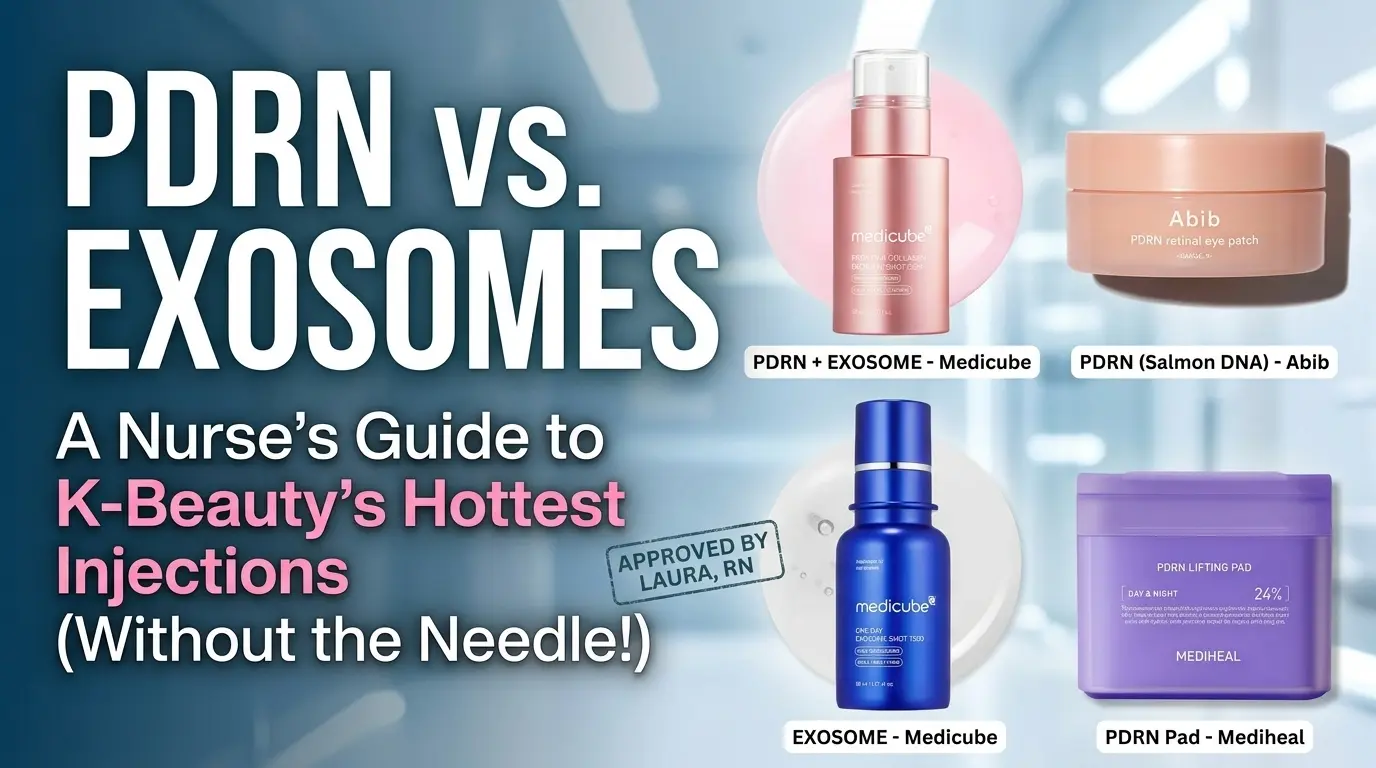
I got back from Cosmoprof North America in Las Vegas last week still buzzing, and not from the free coffee. If you don’t know it, Cosmoprof is basically the trade show for the entire beauty industry, and I spent most of my three days parked in the Korean Pavilion, which is exactly where you’d expect a K-beauty nurse to end up. I wasn’t there for pretty packaging. I was there to find out what’s actually backed by science before it ever lands on our shelves.
Here’s what kept coming up, booth after booth: the industry is moving past “just moisturize it” and into something called bio-regenerative skincare. Two ingredients are driving that shift, and you’re going to keep hearing about them, so let’s get you caught up properly.
PDRN stands for polydeoxyribonucleotide, which is a mouthful, so most people just call it salmon DNA (it’s extracted from salmon sperm cells, which sounds strange but is genuinely well studied). It wasn’t developed for skincare at all originally. PDRN has been used in medical settings for years to help wounds heal and tissue repair itself faster.
Somewhere along the way, dermatologists noticed it did something interesting for skin that wasn’t injured too: it helped strengthen the skin barrier, calmed down inflammation, and gave collagen production a real push. That’s why you’re now seeing it in everything from eye patches to lifting pads instead of just in clinics.
If PDRN is having a moment, exosomes are having a bigger one. This used to be a word you’d only hear inside a dermatology clinic. Now it’s showing up on ingredient lists at the drugstore level, and sales of exosome products have reportedly doubled in just a few months.
Here’s the simplest way I can explain it: exosomes are like messenger cells. Think of them as your skin’s delivery service, tiny, naturally occurring cells that carry proteins and lipids straight to where your skin needs them, specifically to support collagen production and repair.
What makes this different from a typical serum is absorption. Most active ingredients have to sit on your skin and hope to get absorbed. Exosomes work differently because your skin actually recognizes them, which lets them deliver deeper and faster instead of waiting around on the surface. One of the researchers I talked to put it perfectly: exosomes don’t just work harder, they work faster. You’re essentially getting the results of a ten step routine out of a single, well-formulated ampoule.
If you want to see what we currently carry in this category, our PDRN and exosome collection is a good place to start, especially if your skin has felt stuck no matter what you throw at it.
Here’s exactly what landed in subscriber inboxes this month, from the Cosmoprof recap to this month’s must-have picks.

Before you go buy anything new, I want to make sure the products you already own are actually working as hard as they can. These are the five things I tell my patients (and my own family) constantly, and none of them cost a dollar.
Always apply your products from thinnest consistency to thickest: toner, then serum, then cream. If you put a thick cream on first, your watery serums physically can’t get through it afterward.
Apply hyaluronic acid onto damp skin, not dry skin. Humectants like hyaluronic acid need water to grab onto. If your skin is bone dry when you apply it, it can actually pull moisture out of your skin instead of adding it.
Use vitamin C underneath your sunscreen. Vitamin C boosts your SPF’s ability to fight off sun damage, so think of it as giving your sunscreen a shield.
More is not always better. Limit exfoliating acids like AHAs and BHAs to two or three times a week. Overdoing it damages your skin barrier, and barrier care should always come first.
Most people use nowhere near enough sunscreen. Use the length of your index and middle finger together to measure out enough product for your face and neck. No shortcuts here.
People ask me constantly what I actually use myself, so here’s what’s earned a permanent spot in my routine right now.
This is the exact visual we sent our subscribers this month, breaking down what’s trending and why it matters.
 Shop PDRN & Exosome Picks →
Generally yes. PDRN is well tolerated by most skin types, including sensitive and reactive skin, since its original medical use was specifically around calming inflammation and supporting healing. As always, patch test anything new first.
PDRN works primarily by supporting tissue repair and calming inflammation at the barrier level. Exosomes act more like a delivery mechanism, carrying signals and nutrients deeper into the skin to support collagen production. Many newer formulas actually combine both.
No. Both PDRN and exosome products are typically formulated as serums, ampoules, or pads that slot into your existing routine right after cleansing and toning, before your moisturizer.
I’m still testing a few more exosome launches from the show before I bring them into the shop. I don’t put anything on our shelves until I’m sure the science holds up, not just the marketing. If you want first access when those land, our subscription box members always see new arrivals before anyone else.
Stay glowing,
Laura
Your Nurse Bestie