FREE SHIPPING
On all US orders over $100
Get 15% off your first order:
100% Authentic K-Beauty
• Direct US Shipping
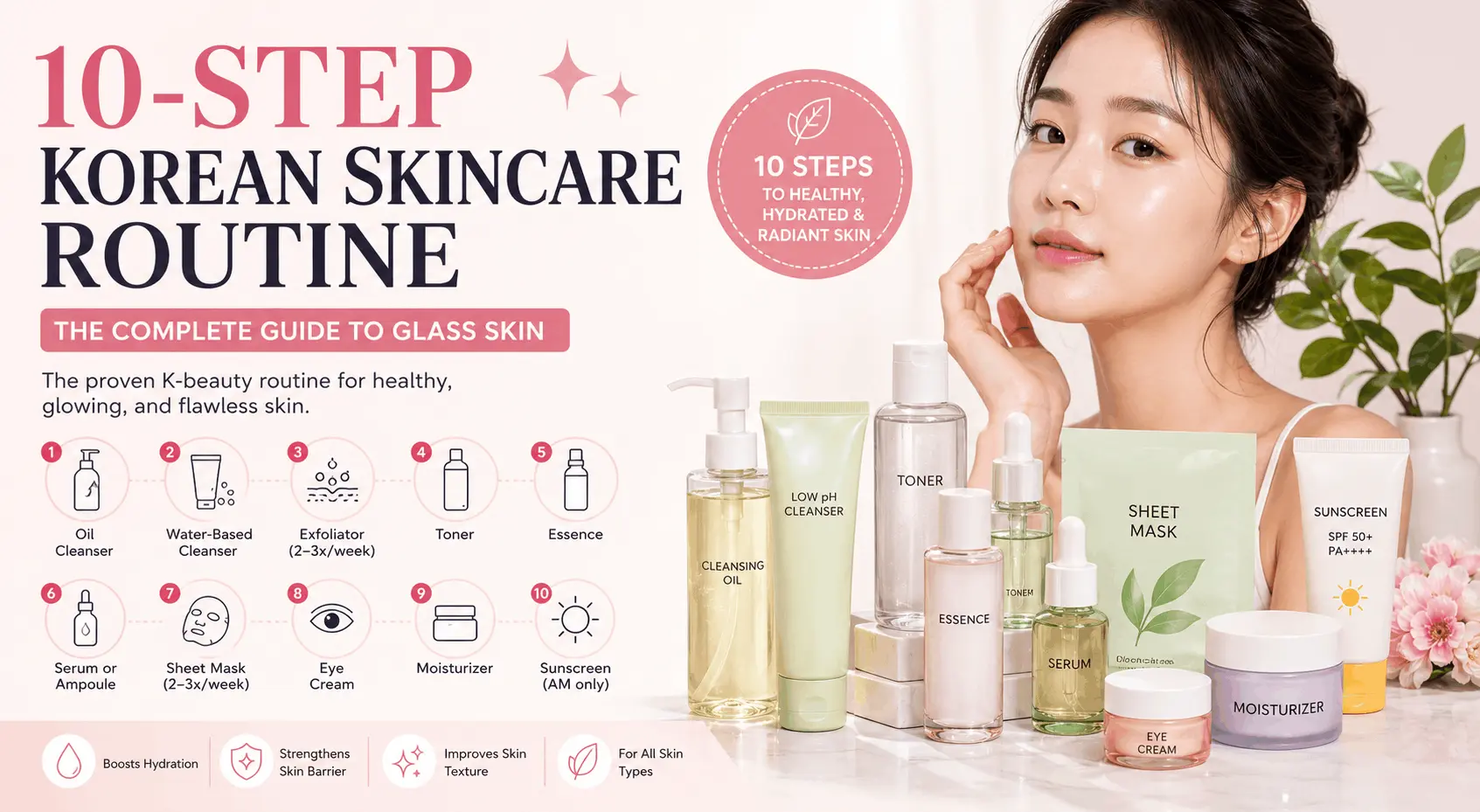
The 10-step Korean skincare routine is the Korean beauty routine that aims to cleanse, treat and protect the skin sequentially with 10 different products. This was created in South Korea and has become international since 2011. In just one daily routine, you can optimize your skin for acne, hyperpigmentation, dryness and dullness.
The 10-step Korean skincare routine is not the 10-step program of using new products. It has to do with the correct sequence of using the appropriate product. There are different tasks for each step. Cleansing removes debris. Toning restores pH. Essences and serums are responsible for delivering actives. Moisturizer seals hydration. Use the company’s best korean Sunscreen for face that prevents damage from the sun’s UV rays.
The principle of Korean skincare is a healthy skin barrier leads to healthy skin. These ingredients, such as Ceramides, Hyaluronic Acid and Centella Asiatica, work directly with that barrier.
The 10 Korean skincare steps are listed below in the correct application order:
This is the standard Korean skincare order followed by most K-Beauty practitioners and dermatologists in South Korea.
An oil-based cleanser cleanses away sunscreen, makeup and sebum. It does not harm the barrier of the skin while dissolving the oil-based impurities. Use best korean oil cleanser over dry skin, apply and massage for 60 seconds and then rinse.
Ideal for: All skin types/even oily skin. Oil dissolves oil. It doesn’t lead to acne.
Suggested ingredients: Jojoba oil, squalane and mineral oil.
A water-based cleanser takes away water-based residues of the oil cleanse, as well as water and dirt. This two-step approach is referred to as “double cleansing. It’s the basis of all Korean skin care regimes, morning and evening. Use a low PH formula. Over time, a high-pH cleaner harm your skin barrier. Use the best korean oil cleansers for maximum benefits.
Exfoliation helps to get rid of dead skin cells and unclog pores. Exfoliate with a chemical one day every two weeks. In K-Beauty, it is not advised to do any physical scrubs as it may cause micro-tears.
Chemical exfoliant types:
Exfoliate no more than once a day. The over-exfoliation process causes the skin barrier to be broken.
Toner is NOT an astringent in Korea. They hydrate the prep layers. After cleansing, the skin’s natural pH is restored with a toner and then it’s ready for the next steps. Massage pat onto skin using hands. Don’t use cotton pads to clean. Wiping and friction occur to remove product.
Key ingredients: Hyaluronic Acid, Niacinamide, Centella Asiatica, Probiotics.
The soul of Korean skin care is an essence. It is a completely light, concentrated liquid formula that penetrates deeply into the skin for effective delivery of active ingredients. Using essences for 4 to 8 weeks results in improved hydration, elasticity and radiance.
The difference between Essence and Toner is that the Toner prepares the skin. Essences treat skin. They do not contain the same product.
Common ingredients used in essence: Fermented extracts, Hyaluronic Acid, Collagen and Niacinamide.
A serum is a potent product that is designed for a specific skin issue. An ampoule is a serum that is more potent. Only use one at a time (when layering, use complementary actives).
By skin concern:
This is where the best Korean skin care regimen begins. Cosmetics like serums and ampoules bring about a skin change that can be measured. This is one of the crucial 10-step Korean skincare routines.
A korean sheet mask is a piece of fiber or hydrogel that is filled with serum. It provides a fast and intense dose of activity, 15-20 minutes. Apply 2-3 times a week for the Korean skincare challenge or weekly for the Korean skin care routine. Do not rinse after removing the sheet mask. Use a brush to apply the remainder of the essence to the skin. Sheet masks stand out as the quickest single-session enhancement in the Korean skin care routine which is known for its gradual, systematic approach. To get the maximum results, you should know about how to use korean face masks.
The thickness of skin around the eye is 0.5 mm. It is 4 times thinner than the other parts of the face. It requires its own product to focus on. Eye creams are designed to treat dark circles, puffiness and wrinkles. Use the ring finger to apply. Tap lightly with fingers and never pull or drag.
Key ingredients: Caffeine, Peptides, Hyaluronic Acid, Ceramides.
Moisturizer close in each layer that was applied before it. It holds water in the barrier layer of the skin and helps to reduce the transepidermal water loss (TEWL).
By skin type:
Sunscreen is the most crucial part of the Korean beauty routine. 80% of visible skin ageing is due to UV damage. It also aggravates the acne scars and hyperpigmentation.
Apply SPF 50 PA++++ sunscreen at least daily. Use as a last step in the morning.
SPF types:
Reapply every 2 hours when in the sun.
Adapting the Korean skincare routine am and pm requires changing your final topical layers based on environmental exposure.
The skin is exposed to UV radiation and pollution during the day, and needs a large supply of antioxidants and sunscreen. The skin goes through a recovery phase at night, when it is the perfect time to nourish with rich treatments such as peptides and sleeping packs.
| Essential Attribute | Formula Value |
| Primary Ingredient | Hyaluronic Acid and Ceramides |
| Key Benefit | Rebuilds the intercellular lipid matrix and holds 1000 times its weight in water |
| Routine Frequency | 2 times daily (AM and PM) |
Overproduction of sebum characterizes oily skin. The aim is not to remove the oil from the tree. The idea is to even it out. Use gel cleanser, Niacinamide toners and lightweight gel moisturizers. Exfoliants in BHA open up the pores. Oily skin will get worse if you don’t apply moisturizer. Dry skin produces excessive sebum to make up for the lack of moisture. By using the korean skincare routine for dehydrated skin, you can hydrate your skin properly.
The acne Korean skin care routine targets 3 areas: killing bacteria, reducing inflammation and diminishing the appearance of post-acne spots.
Ingredients that fight acne:
Don’t use benzoyl peroxide or vitamin C and retinol at the same time. Both are inactivated.
Hormonal changes cause teenage skin to be more reactive and oilier than it is at other times. The 10 steps are complicated and a 5-step version is more suitable.
Recommended steps for teenagers:
Introduce one new product every 2 weeks. This prevents breakouts from product overload.
The Korean body care routine is similar to the facial routine with regard to the principle. Wash, scrub, moisturize and safeguard.
4-step body routine:
Centella Asiatica body lotions are favored to soothe irritated and KP skin.
When choosing the best Korean skincare for combination skin, it is important to use a combination of targeted and flexible layering methods that will help to balance the oily T-zone and dry cheeks.
For combination skin, use a cleanser tonic to the forehead and nose and then top with a heavy cream with probiotics onto the cheeks. This two-in-one solution ensures an ecological balance in different areas of the face.
At Korean Beauty Bar, they have more than 200 authentic Korean Beauty products available from South Korean brands. All products are direct from the manufacturers from Korea.
Shop the full range at koreanbeautybar.com.
Top categories:
Free shipping on orders over a set threshold. New arrivals are added weekly.
No. A five-step routine (cleanser, toning water, serum, moisturizer, SPF) is used on hectic days. Use any steps such as exfoliation and sheet masks, 2-3 times a week.
Yes. Start with 5 steps. Apply one product every 2 weeks. Before applying to the face, patch on the inside of the arm and wait for 24 hours before use.
Yes, with fragrance-free, low pH formulas. It’s good for sensitive and reactive skin types because of the presence of Centella Asiatica and Ceramides.
Hydration becomes better in 3-5 days. It takes 2-4 weeks to develop texture. Hypopigmentation clears up in 6-12 weeks. There are no time delays in the benefits of SPF.