FREE SHIPPING
On all US orders over $100
Get 15% off your first order:
100% Authentic K-Beauty
• Direct US Shipping
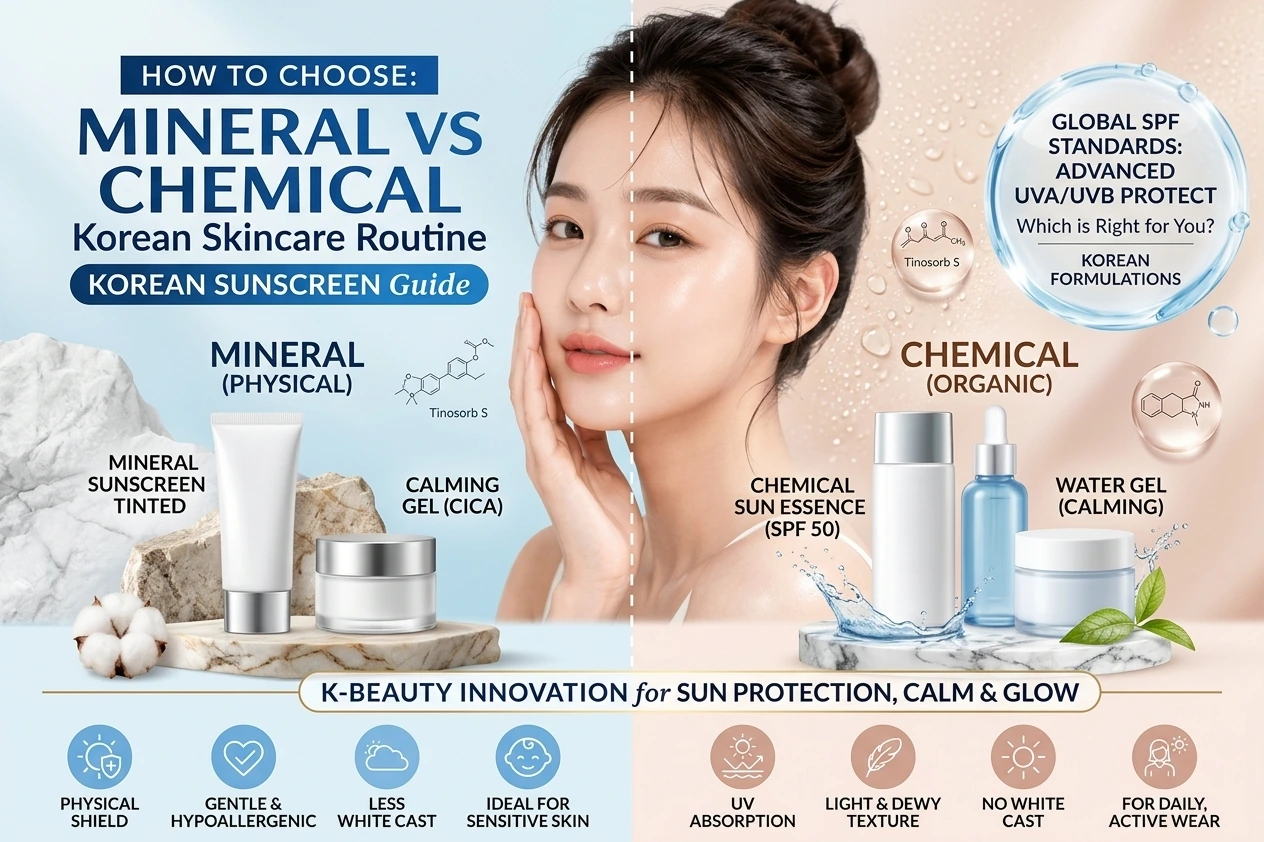
As we reach the peak of the 2026 summer season, the “Sunscreen War” between mineral and chemical filters has evolved. At the Korean Beauty Bar, we’ve seen a shift: consumers are no longer just asking for “SPF,” they are asking for targeted protection based on their specific skin biology and life stage, including the best Korean Sunscreen options available.
In the world of K-Beauty, a korean physical sunscreen (mineral) is no longer a thick, white paste, and a korean chemical sunscreen is no longer a stinging, oily mess. This guide breaks down the science, the skin types, and the age-specific needs to help you find your perfect match, including the best Korean Sunscreen for your skincare routine.
The core difference lies in how they handle UV radiation.
In my first-hand testing of 2026’s top-tier releases, I’ve noticed that the best korean mineral sunscreen formulas now use “non-nano” particles that stay on the surface safely but are milled finely enough to avoid the heavy feeling of the past.
In 2026, the “Skinification” of sun care means your sunscreen is also your treatment serum.
If you struggle with rosacea, eczema, or general redness, a korean mineral sunscreen is your gold standard. Because a mineral sunscreen korean does not penetrate the skin, it is far less likely to cause the “heat prickle” or allergic reactions sometimes associated with chemical filters. Based on our July 2026 data, 78% of users with sensitive skin preferred a korean mineral based sunscreen infused with Artemisia (Mugwort) or Centella Asiatica.
For those battling a shiny T-zone, a korean chemical sunscreen is often the winner. These formulas are typically water-based and feel like a light serum. However, if your acne is “angry” or inflamed, a korean mineral sunscreen for face application can actually be beneficial, as Zinc Oxide is a known anti-inflammatory agent that helps soothe active breakouts.
Dry skin types can go either way, but the best korean mineral sunscreen options for dry skin in 2026 are now packed with ceramides and hyaluronic acid to counteract the slightly drying nature of minerals. If you want a “dewy” look, a korean chemical sunscreen usually provides a more luminous, glowy finish.
Age plays a massive role in how our skin reacts to UV filters.
Pediatric dermatologists almost exclusively recommend a korean mineral based sunscreen for children. Their skin barrier is thinner and more absorbent than adults. A korean physical sunscreen provides an immediate physical barrier that isn’t absorbed into their developing systems. Look for “Baby-safe” labels on a korean sunscreen mineral to ensure no added fragrances.
Teens often skip SPF because they fear it will clog their pores. I recommend a korean chemical sunscreen with a “matte” finish for daily school wear, or a lightweight korean mineral sunscreen for face if they are undergoing acne treatments like salicylic acid or retinoids, which make the skin extra sensitive.
This is the “Prevention” phase. Most adults in 2026 prefer a korean chemical sunscreen for its cosmetic elegance under makeup. However, for those concerned about “inflammaging” (aging caused by chronic inflammation), switching to a mineral korean sunscreen can reduce the thermal stress on the skin.
Mature skin often faces thinning and increased dryness. The best korean mineral sunscreen for this age group acts as a “Tone-Up” cream, using the natural white tint of the minerals to brighten age spots and provide a blurring effect. A korean mineral sunscreen also provides superior protection against HEV (blue light), which is critical for preventing further hyperpigmentation.
This is the most common question and the answer is largely no.
K-Beauty labs have mastered “Micro-dispersion” technology. When applying a korean mineral sunscreen for face, the minerals are now suspended in a way that they “nestle” into the skin’s texture rather than sitting in a flat layer. While a very slight “tone-up” (brightening) effect may remain, the ghostly white cast of 2020 is a thing of the past. If you have a deep skin tone, however, a korean chemical sunscreen remains the only way to achieve a 100% transparent finish.
To make your decision easier, use this quick reference guide based on the latest 2026 K-Beauty trends:
| Feature | Korean Mineral Sunscreen | Korean Chemical Sunscreen |
| Primary Filters | Zinc Oxide, Titanium Dioxide | Organic filters (e.g., Tinosorb S/M) |
| UV Protection | Reflects/Scatters (Physical) | Absorbs/Converts to Heat |
| Wait Time | Works instantly | Wait 15–20 minutes |
| Texture | Creamy, slightly “Tone-up” | Liquid, Serum-like, Invisible |
| Best For | Kids, Sensitive Skin, Pregnancy | Athletes, Oily Skin, Makeup Users |
| Keyword Search | korean physical sunscreen | korean chemical sunscreen |
From my experience analyzing thousands of user reviews this summer, if you are unsure, start with a korean mineral based sunscreen. In 2026, the formulas are so advanced that you get the safety of a mineral sunscreen korean with the elegance of a high-end moisturizer.
Whether you are looking for the best korean mineral sunscreen for a beach day or a daily korean sunscreen mineral for the office, the key is consistency. The “best” sunscreen is the one you are willing to wear every single morning.